
Quick Start
If you read nothing else, read this
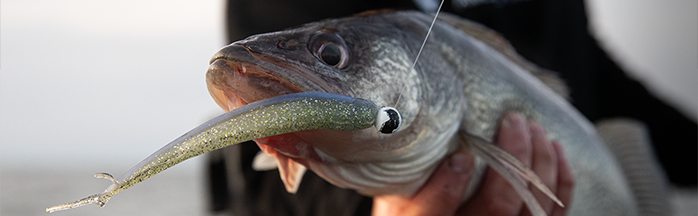
- Start with a 3–3.5" paddletail: best search bait in spring — vibration triggers fish in cold, stained, or low-light water across all depths.
- Downsize after cold fronts or in clear water: switch to a 3" minnow or jerk shad — less action, more natural profile, better for neutral fish.
- Go finesse when bites are short: a ringworm or curl tail produces action at the slowest retrieve speeds and converts short strikes when other profiles miss fish.
- Size the body to the hook gap: the hook should exit cleanly near the back third of the bait — if it's at the tail or buried in the body, you'll miss fish.
The 3 Core Profiles
You don't need a tackle tray full of plastics. Three profiles — one high-action, one natural, one finesse — cover every spring condition you'll face. Learn what each one does and you'll know exactly which to reach for.
Profile 01
Paddletail
Best search bait · Most conditions
The flat paddle-shaped tail beats rhythmically as the jig moves, producing vibration that walleyes detect at distance in low-visibility water. The paddletail is the default spring choice — it covers water efficiently, works at all retrieve speeds, and produces a thump that reactive fish can't ignore.
- Size: 3–3.5" standard, 2.5" in very cold or clear water, 4–4.5" post-spawn.
- Best in: stained water, low light, wind-blown conditions, water below 55°F.
- Key retrieve: slow drag-pause on bottom; tail keeps kicking even at minimal speed.
Profile 02
Minnow / Jerk Shad
Neutral fish · Clear water · Cold fronts
A straight or lightly tapered body that mimics a baitfish without the aggressive vibration of a paddletail. The minnow profile glides on the fall — deadly on a snap-and-fall retrieve. When clear water demands subtlety, or after a cold front turns fish neutral, this is the switch to make.
- Size: 3" standard, 2.5" in cold water (below 44°F) or for short biters.
- Best in: clear water, post-frontal conditions, 15+ ft depths, slow dead-stick presentations.
- Key retrieve: snap-and-fall or slow drag with 3–5 second pauses.
Profile 03
Ringworm / Curl Tail
Finesse · Pressured fish · Short biters
The curled tail produces action at the slowest possible retrieve speeds — even at rest, water movement causes the tail to twitch. This makes it ideal for very slow drags in cold water and for converting fish that tail other profiles without committing. The hook also sits further back in the body, converting short strikes that other profiles miss.
- Size: 3–4" standard ringworm, 2.5" curl tail for ultra-finesse.
- Best in: very clear water, pressured fish, cold-water dead-sticking, recurring short strikes.
- Key retrieve: ultra-slow drag or dead-stick with minimal movement between pauses.
When to Use Each Profile
Profile selection starts with conditions — water temperature, clarity, and fish activity level. Use this as a quick reference before you rig up.
| Condition | Start With | Switch To |
|---|---|---|
| Water 36–44°F | 3" Minnow / Jerk Shad | 2.5" Ringworm if bites are short |
| Water 44–52°F | 3–3.5" Paddletail | 3" Minnow after cold fronts |
| Water 52–60°F+ | 3.5–4" Paddletail | Jerk shad for snap-and-fall |
| Clear (3+ ft vis) | 3" Minnow, natural colors | Ringworm if fish are spooky |
| Stained (<2 ft vis) | 3.5" Paddletail, contrast colors | Larger paddle if still no bites |
| Post-frontal / neutral | 3" Minnow, slow dead-stick | Ringworm with extended pauses |
| Active / feeding fish | 3.5–4" Paddletail | Faster retrieve, light snap-lift |
| Recurring short strikes | Ringworm / Curl Tail | Smaller body on same jig head |
Temperature is the first variable
In cold water (below 44°F), walleyes are metabolically slow — they want a subtle bait they don't have to chase. Paddletails work, but the action must be barely perceptible. Minnow profiles with a dead-stick retrieve are often more effective because they produce less resistance and sink slowly through a fish's field of view. When in doubt, slow down before you switch profiles.
Color Selection
Color is the last variable to dial in — get profile, size, and depth right first. When you're ready to optimize, these rules cover most situations.
Clear Water · Bright Conditions
Natural Patterns
Stained Water · Low Light · Deep
Contrast Patterns
Any Condition
The Two-Color Rule
Plastics + Jig Heads
The right plastic profile paired with the right jig head covers every depth and condition spring walleye fishing throws at you.
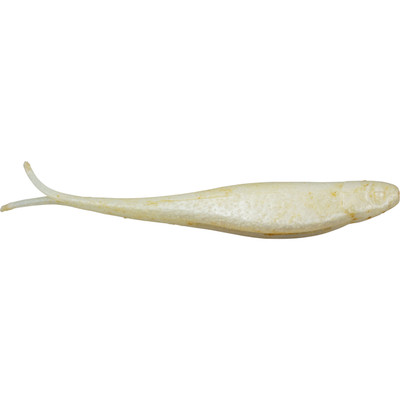
Spring Plastics Kit
Paddletail + minnow + jig heads — the core spring walleye rotation



Matching Profile to Jig Head
The right plastic on the wrong jig head produces short bites and missed fish. Hook gap, head style, and weight all affect how the plastic sits and how the hook connects on the strike.
More detail on these techniques
- Spring Walleye Hub — seasonal overview and all spring content
- Walleye Jerkbait Hub — cadence, rod angle, and retrieve variations
- Spring Jigging Setup — complete rod, reel, line, leader, and rigging guide
Common Mistakes
Most missed fish on spring plastics come down to sizing, rigging, or sequencing errors. All are quick fixes once you know what to look for.
Read Next
FAQ
A 3–3.5 inch paddletail is the best starting point. It produces vibration that triggers fish in colder, stained, or low-light water and works at all depths when paired with the right jig head. If paddletails aren't producing after a thorough effort — especially post-frontal or in very clear water — switch to a minnow or jerk shad profile.
3 to 3.5 inches covers most spring conditions. Go smaller (2.5–3") in water below 44°F or for finicky fish. Go larger (4–4.5") once temps hit 52°F+ and fish are more aggressive. Always match body length to your jig hook gap — the hook should exit cleanly near the back third of the body.
Switch to a minnow or jerk shad when: the water is very clear and fish are spooking, after a cold front when fish are neutral and slow, when bites are short, or when fishing 18+ foot depths with a dead-stick presentation. The minnow profile also shines on a snap-and-fall retrieve where it glides on the drop and hangs on the pause.
In clear water and bright conditions: natural shad (white/silver), perch (green/yellow/orange), and goby (brown/olive) patterns. In stained water, low light, or deeper water: chartreuse, white, or orange contrast patterns. Start natural and switch to high-contrast if you're not getting interest after a thorough drift. Color is the last variable to change — profile, size, and presentation come first.
Short bites usually come down to three things: (1) the hook exits too close to the tail — try a longer plastic so the hook exits at the midsection, (2) the presentation is too fast — cold-water walleyes need time to commit, so slow down and extend pauses to 3–5 seconds, (3) fish are striking the tail of a paddletail — switch to a ringworm or curl tail where the hook sits further back in the body.
Not required, but it helps in cold water when fish are slow and holding plastics briefly before dropping them. Pre-scented plastics (Berkley Gulp!, Z-Man ElaZtech) are the easiest approach — no extra steps needed. If you're using non-scented plastics, a quick application of fish attractant can extend hold time. In water above 50°F with active fish, scent matters less than presentation and profile.
Thread the plastic so the eye of the hook sits flush at the nose of the bait. The hook bend should exit the body at the back third to midsection, with the tail section free to move. If the hook exits at the tail tip, the plastic is too short. If the hook bend is buried under too much body material, the plastic is too long — both situations will cause you to miss fish.
Ringworms and curl tails outperform paddletails in three situations: very clear water where subtle action looks more natural; pressured fish that have seen a lot of paddletails; and finesse situations where you're dead-sticking or fishing very slowly on bottom. The curl tail produces action on the drop and at very slow retrieves where a paddletail stops kicking. It's also the better choice on a light (1/16–1/8 oz) jig head or a Ned-style mushroom head.